






Mantis – Just a Gadget or a Genuinely Useful Shooting Training Tool?
Anyone who trains regularly knows how easy it is to become accustomed to their own mistakes. Sometimes, all it takes is a slight movement of the hand during a trigger press to send shots somewhere other than where we intended. Worse still, we often struggle to identify the cause. We feel like we’re doing everything exactly the same way, yet the results keep changing.
Of course, we can ask an instructor to evaluate our technique, record a training session, or simply spend more time practicing. The problem is that an instructor isn’t always standing next to us, and adding more repetitions won’t necessarily help if we’re making the same mistake over and over again.
American company Mantis decided to approach this problem through technology. Its devices track firearm movement and transmit data to an app that helps analyze what’s happening during an exercise.
Sounds promising, but the market is full of electronic gadgets that fascinate their owners for the first couple of weeks before ending up forgotten in a drawer.
We’ve been working with Mantis products on a daily basis. For almost a year now, our CSJ – Centrum Strzeleckie Jammas (Jammas Shooting Center) in Łomianki, Poland, has been home to a Mantis Demo Center, where visitors can try out nearly the entire product lineup from the American manufacturer. We also have access to more advanced training systems that haven’t yet entered regular commercial distribution.
That has given us plenty of opportunities to take a closer look at the technology. In this article, we’ll explore the main Mantis systems, with particular attention to the TitanX – a training pistol that made a very positive impression on us, although we did find a few things worth criticizing.
MantisX, Laser Academy, Blackbeard… What’s the Difference?
First, let’s make some sense of the product lineup, because the Mantis name covers several different training systems. They share a common purpose, but the way they help shooters improve can be quite different.
The best-known product family is MantisX. These are compact sensors that attach to a firearm and contain electronics capable of tracking its movement. The collected data is sent to a mobile app, where users can analyze firearm stability, trigger control, and the movements occurring around the moment a shot is fired.
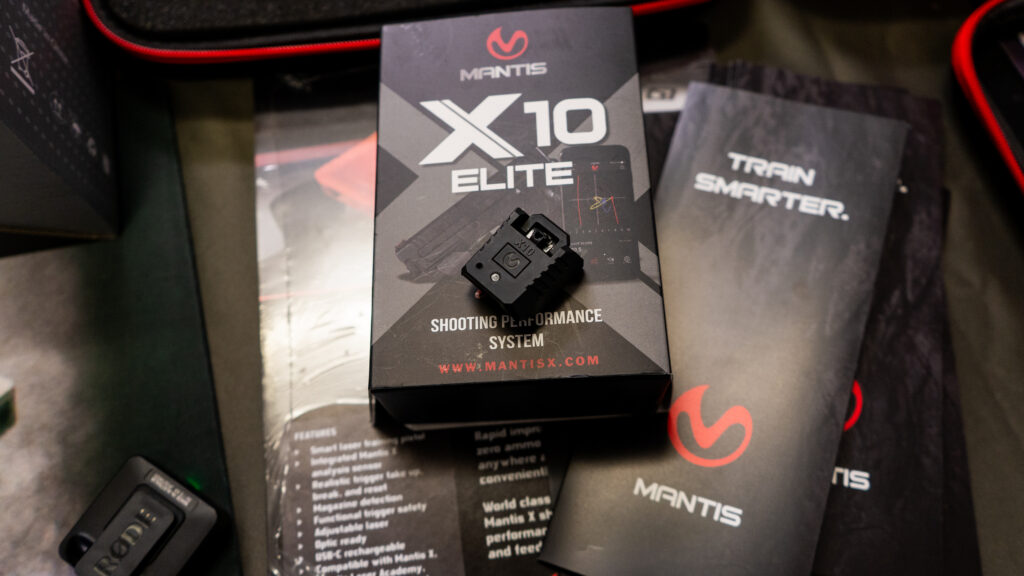
The system comes in several versions. The entry-level Mantis X2 is designed for dry-fire training, while the Mantis X3 can also be used during live fire. The Mantis X10 Elite offers the most comprehensive set of analytical features, including recoil analysis, holster draw analysis, and additional capabilities useful for dynamic shooting exercises.
There’s no magic involved. The sensor records specific movement parameters, and the software attempts to interpret them. This makes it possible to identify recurring problems that might otherwise go unnoticed.
Another solution is Mantis Laser Academy. This system uses a laser, targets, and a smartphone camera to register simulated hits. The app offers different drills, timing functions, and performance tracking. Dedicated targets that the app recognizes automatically are the most convenient option, although users can also define target zones manually.
The distinction between these systems is important. MantisX focuses on how the firearm behaves during trigger operation, while Laser Academy shows where a simulated shot would have landed. They can be used independently, but with the right setup, they complement each other very well. The manufacturer has also been gradually integrating features from both applications, allowing users to combine basic movement analysis with laser hit detection.
Mantis hasn’t forgotten about AR-platform owners either. For them, the company developed Mantis Blackbeard, a system that automatically resets the trigger during dry-fire training. Anyone who has practiced repeated trigger presses with an AR-15 knows how frustrating it can be to manually cycle the action after every press. Blackbeard solves that problem, while the more advanced BlackbeardX adds firearm movement analysis.
The BlackbeardX family is no longer limited to the AR-15, either. The manufacturer now offers variants for other platforms, including the AR-10, SIG MCX, FN SCAR, and SIG M7. Naturally, compatibility with a specific firearm configuration should always be verified before purchasing.
Each solution has its strengths, and choosing the most advanced device isn’t necessarily the best decision. It all depends on what, exactly, you want to practice.
Raven and Mixed Reality. Mantis Has a Few More Ideas
Mantis development doesn’t stop at firearm-mounted sensors and applications that analyze trigger control. The company is also developing systems that bring laser training into more complex, interactive scenarios.
One such solution is Mantis Raven, which is already available at our Demo Center in Łomianki.
Raven uses a projector to display interactive scenarios and a smartphone camera to detect laser hits. Instead of shooting at a traditional target, users can practice on targets projected onto a large surface, respond to changing situations, or compete with other participants.
The system was introduced at SHOT Show 2025, and we’ve since made it available at CSJ as part of our expanding training setup. It’s an interesting example of how the relatively simple concept of laser hit detection can be developed into something that makes training considerably more engaging.
Raven also takes a somewhat different approach from the traditional MantisX system. Rather than focusing on charts and detailed analysis of every movement, it allows users to perform drills in an interactive environment. It certainly doesn’t replace a real shooting range, but it can be a valuable addition to regular training.
Another area of development involves Mixed Reality (MR) systems. In this environment, users see virtual elements overlaid onto the physical world, opening up possibilities for entirely different training scenarios.
During SHOT Show 2026, we had the opportunity to explore this technology and reach an agreement with the manufacturer to supply our Demo Center with the first unit intended for testing and sale in the European market.
The technology promises some exciting possibilities, but we’d rather reserve judgment on its practical value until we’ve had the opportunity to conduct our own tests. Being new and impressive isn’t, by itself, enough to make something useful.
For now, let’s return to a device we’ve already spent considerable time with – one that, in a way, brings together some of the most important features found across the Mantis ecosystem.
TitanX. A Pistol That Can’t Fire Live Rounds but Still Offers Plenty of Training Opportunities
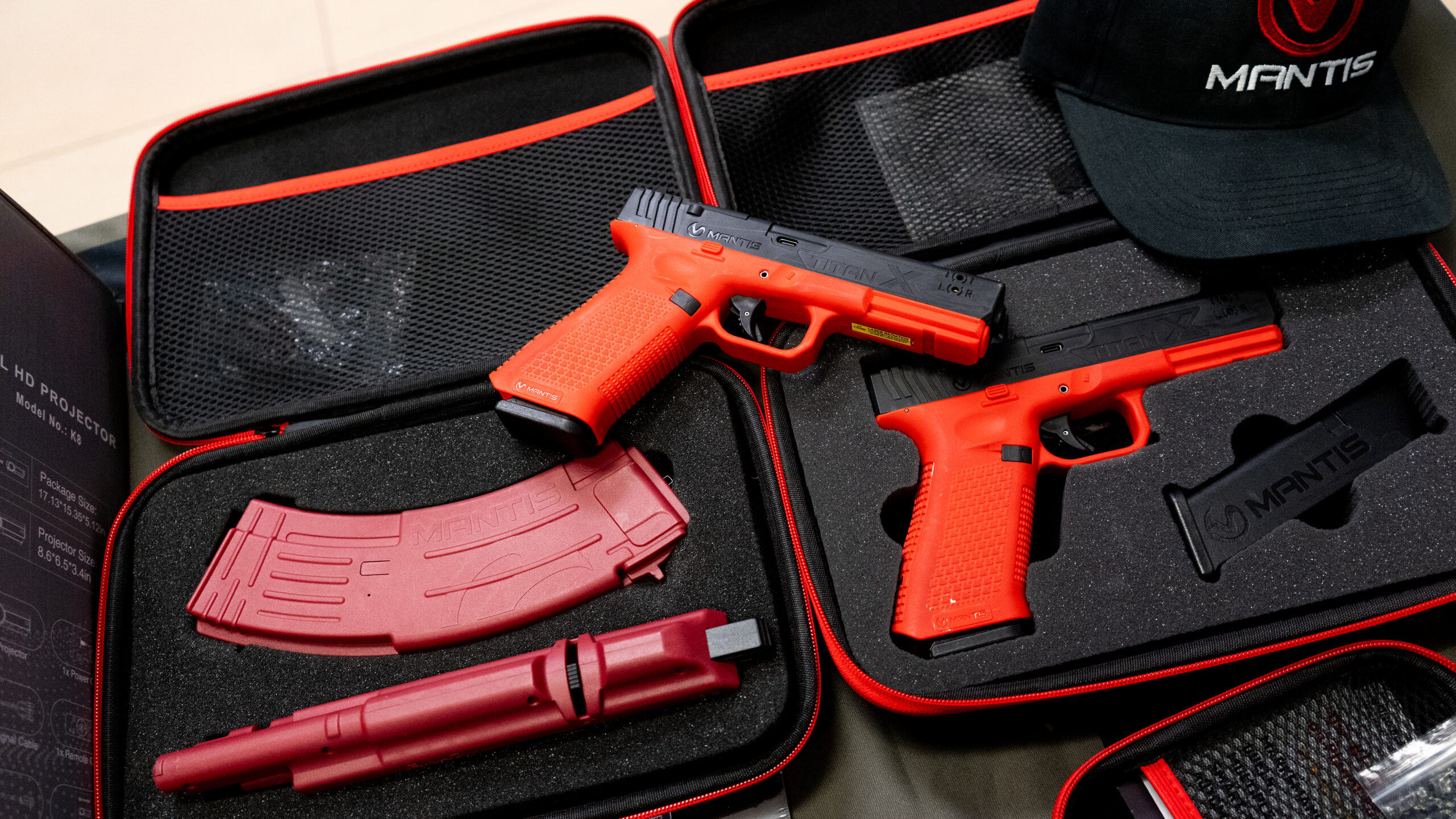
The Mantis TitanX closely resembles popular Glock pistols, and its ergonomics are based on that familiar platform. The manufacturer offers versions corresponding to selected characteristics of the Glock 17, 19, and 45.
However, this isn’t a real pistol that has simply been rendered incapable of firing, nor is it an ordinary plastic replica. TitanX was designed from the ground up as a standalone training device. It features an integrated MantisX system, a laser, and an automatic trigger reset mechanism.
Importantly, the analytical capabilities of its built-in system are comparable to those of the Mantis X10 Elite, excluding functions that require live ammunition. This means users can access more than just basic technique analysis. The system also supports more advanced exercises, including holster draws and movement analysis during dynamic training.
In practice, you take the device out of the box, connect it to the app, and start training without using an actual firearm.
Our first impressions during testing were positive.
Ergonomics and Weight – Mantis Got This Part Right
One of the first things that stands out about TitanX is its build quality and balance. The construction feels solid, the grip sits comfortably in the hand, and the device has enough weight that it doesn’t feel like a toy.
The weighted magazines contribute significantly to that impression. It’s only when you remove a magazine that you really notice how much it affects the overall balance.
Two magazines are included, allowing TitanX to be used for magazine change drills as well. Naturally, performing these exercises won’t feel exactly the same as working with a real firearm, but the system is certainly useful for practicing and reinforcing specific movement sequences.
Interestingly, with the October 2026 update to the MantisX app, the manufacturer also introduced a new feature called Mag Change Analysis, developed specifically for TitanX. It allows users to analyze the magazine change process, breaking it down into individual stages and highlighting areas that may need improvement. It’s an interesting expansion of the device’s capabilities, although we’ll need more training sessions before drawing conclusions about its practical value.
TitanX also supports compatible red dot sights and selected rail-mounted accessories. It can be used with many holsters designed for the corresponding Glock models, making it easier to replicate a shooter’s existing equipment setup.
Overall, TitanX performs very well in terms of ergonomics. That doesn’t mean it’s indistinguishable from a Glock, but the differences didn’t interfere with our basic training exercises.
The Trigger – Good, but Not Quite the Real Thing
This is where we have a few more reservations.
One of TitanX’s greatest advantages is its automatic trigger reset. It allows repeated trigger presses without having to manually cycle the device, which makes longer training sessions considerably more convenient.
However, the feel of the trigger mechanism leaves something to be desired.
The manufacturer clearly tried to replicate the characteristics of a factory Glock trigger, but in our opinion, the result isn’t a perfect match. The differences are noticeable, particularly at the break and in the overall feel of the trigger pull.
For training focused on movement control, grip stability, and consistent trigger operation, we wouldn’t consider this a significant disadvantage. However, anyone expecting to practice with a mechanism that feels exactly like the trigger on their actual Glock should be aware of this limitation.
That doesn’t change the fact that automatic reset is a major convenience, especially when you’re planning to perform dozens or even hundreds of repetitions rather than just a handful.
MantisX in Practice. Can the App Actually Tell You Something Useful?
One of TitanX’s biggest advantages is having the MantisX system built directly into the device, eliminating the need to attach an external sensor.
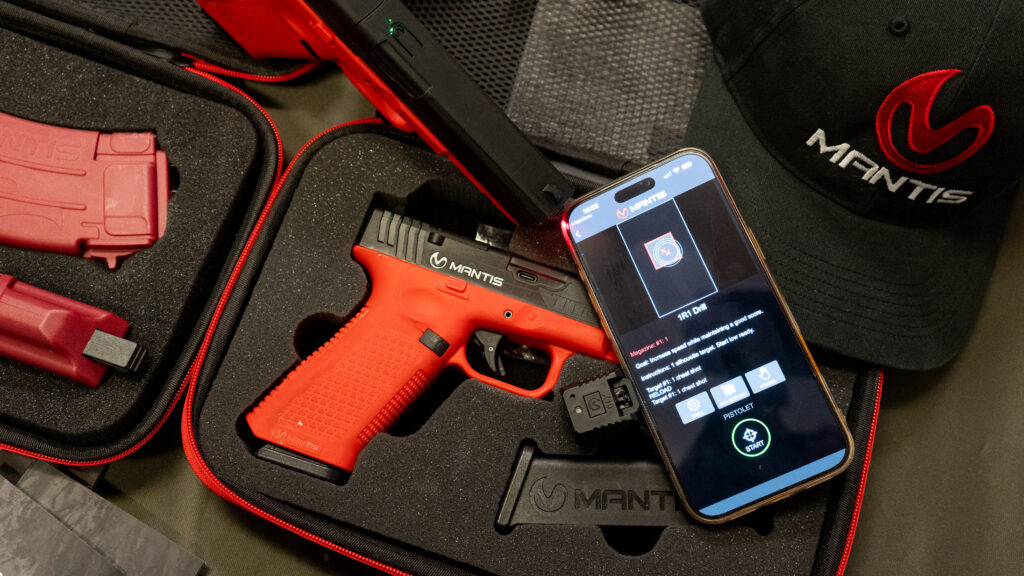
Once connected to a smartphone, the device provides access to a comprehensive app that analyzes movement during exercises, evaluates stability, and displays results for individual repetitions. It also includes structured training programs, so users don’t have to come up with every drill themselves.
The app made a good impression on us. The interface is clear, results are presented in an understandable format, and using it doesn’t require any special technical knowledge. The availability of a Polish-language version is another advantage for our local users, although some elements of the app haven’t yet been fully translated.
What interested us most, however, was the opportunity to look at shooting technique from a different perspective.
During one exercise, we noticed that one of our testers was placing his trigger finger considerably deeper than he had previously realized. That isn’t necessarily a mistake in itself. A lot depends on hand anatomy, grip size, and trigger characteristics. What matters most is whether pressing the trigger introduces unwanted movement into the firearm.
Under normal circumstances, details like this are easy to overlook, especially when practicing alone and concentrating primarily on the target.
Mantis allows us to analyze what’s happening to the device during trigger operation. It doesn’t directly show finger placement, but the recorded movement can prompt us to examine particular aspects of our technique more closely.
That’s exactly what happened in our case.
It’s a good example of why the value of Mantis doesn’t lie in automatically identifying the cause of every mistake. Its real strength is providing information that helps the shooter consciously identify the problem.
It’s also worth maintaining a healthy degree of skepticism toward the app’s suggestions. The system doesn’t know the anatomy of our hands or every circumstance surrounding a particular exercise. It can detect certain movement patterns, but interpreting them remains the responsibility of the shooter or instructor.
TitanX and Laser Academy – What Do You Gain by Combining Them?
The built-in laser allows TitanX to work with the Laser Academy app as well. This means that, in addition to movement analysis, users can register simulated hits on targets.
It’s a useful combination because a MantisX score alone doesn’t tell the whole story.
We might perform an exercise in which the device records relatively little movement, yet the simulated hit appears somewhere other than where we intended. Conversely, we might achieve a good result on the target while the movement analysis still reveals certain issues.
Combining these two sets of information provides a more complete picture of the training session.
Importantly, the latest versions of the apps already allow some integration between the two systems. MantisX offers basic laser hit detection, while Laser Academy provides selected movement analysis features when connected to a compatible device.
It’s worth remembering that access to the MantisX Pistol/Rifle app is included with TitanX, while the full range of Laser Academy exercises requires separate access. Simply being compatible with the app doesn’t automatically unlock all its features.
We should also remember that the laser indicates a simulated point of impact, not the actual behavior of a bullet. It doesn’t account for ballistics or all the physical effects associated with live-fire shooting.
Nevertheless, for practicing selected aspects of shooting technique at home, this combination may be more than sufficient.
Training at Home Has One Advantage That’s Hard to Overstate
A trip to the shooting range involves travel, equipment preparation, the training session itself, and the journey back. Even if the actual shooting takes only an hour, the entire process usually requires considerably more time.
Not everyone can make that trip several times a week.
Dry-fire training is different. In a properly prepared space, we can spend just fifteen or twenty minutes practicing and do it much more frequently. There’s no ammunition consumption, and setting up for a session takes very little time.
TitanX is particularly convenient in this respect because it doesn’t require an actual firearm. There’s no need to install additional devices, and the automatic trigger reset allows us to concentrate on the exercise itself.
Of course, even when using a training device that cannot fire live ammunition, basic safety precautions still matter. That includes choosing a suitable training area and using the laser responsibly. TitanX exercises should also be kept separate from the handling of real firearms.
This accessibility encourages consistency, and consistency plays an enormous role in training.
Naturally, buying a TitanX doesn’t automatically mean saving money. The trainer itself costs money, and whether the investment makes sense depends on how often it’s used.
For someone who plans to practice once every few months, purchasing an advanced training device may simply not be justified.
For someone who trains regularly and wants to move part of that practice into the home, the calculation looks quite different.
Let’s Be Clear – It Won’t Replace Live Fire
TitanX has limitations that the manufacturer shouldn’t overlook and users shouldn’t ignore.
First and foremost, there’s no recoil. There’s no gunshot, no muzzle rise, and none of the physical or psychological responses associated with the full range of stimuli experienced during actual shooting.
That means we can’t use it to practice recoil management in the same way we would at the range. Nor can we be certain how the habits we’ve developed will translate into live-fire conditions.
What we can do is work on many elements that don’t require firing a real shot: grip, presentation, trigger control, sight alignment, and movement consistency.
It’s also important to remember that a high score in the app isn’t necessarily proof of improved real-world accuracy. Ultimately, progress needs to be verified during regular live-fire training.
On the other hand, the absence of noise and recoil is precisely what makes TitanX suitable for home use. If it behaved exactly like a real pistol, its usefulness in a residential environment would be rather limited, and the neighbors would probably have something to say about it.
The point is to understand that TitanX is designed to develop specific skills. It isn’t a simulator of every condition encountered during live-fire shooting.
Is Mantis Worth Buying?
Based on our experience with TitanX and the other systems available at our Demo Center, it’s difficult to dismiss Mantis products as ordinary electronic toys. The technology serves a clear purpose, and movement analysis can genuinely help identify mistakes that might otherwise go unnoticed during individual practice.
That doesn’t mean every shooter needs one.
Someone primarily interested in analyzing trigger control on their own pistol will probably benefit more from an appropriate MantisX model, particularly if they also intend to use it during live fire.
An AR-platform owner might appreciate Blackbeard’s automatic trigger reset more, while someone interested mainly in laser-based training may find that Laser Academy is all they need.
TitanX is particularly interesting for people who want a complete device for regular pistol training, without needing to use a real firearm, with automatic trigger reset and access to advanced MantisX analysis and laser-based exercises.
During our tests, we appreciated the build quality, ergonomics, balance, and ease of use of the app. Our biggest reservation concerns the trigger, which doesn’t perfectly replicate the feel of a factory Glock mechanism. Users also need to accept the absence of recoil, although that’s hardly a surprising limitation for a device designed specifically for dry-fire training at home.
In our view, TitanX works best as a complement to regular range sessions. It allows users to perform numerous repetitions, analyze selected aspects of their technique, and work on them whenever time permits.
The Best Way to Find Out Is to Try It Yourself
There’s a particular problem with training devices. You can read a dozen reviews, watch the manufacturer’s videos, and study every technical specification, yet still have no clear idea whether a particular solution is right for you.
That’s why, for almost a year now, we’ve been operating a Mantis Demo Center at CSJ – Centrum Strzeleckie Jammas, located at ul. Pancerz 6 in Łomianki, near Warsaw. Visitors can personally test nearly the entire Mantis product family, from traditional MantisX analyzers through Laser Academy and Blackbeard to TitanX and more advanced training systems such as Raven.
More recently, a Mantis demonstration station has also become available at our second location – Strefa Celu, at al. Waszyngtona 100A in Warsaw.
This gives visitors the opportunity to see how the different devices work, compare their capabilities, and decide whether this approach to training actually suits their needs before making a purchase.
Our experience has shown us that not every shooter needs an advanced training system. For one person, a basic MantisX may be perfectly sufficient. Another will appreciate the capabilities of Laser Academy, while someone who practices regularly with a pistol may find that TitanX is exactly what they’ve been looking for.
The problem is that you can’t make that decision based on technical specifications alone.
That’s precisely why we’re continuing to develop our demonstration facilities. We want everyone interested in these systems to have the opportunity not only to see the equipment but also to try it in practice and determine whether it genuinely solves a specific training problem.
Because technology makes sense when it helps you achieve a particular goal. Not simply because it can generate yet another impressive-looking chart.
