




Does introducing young people to firearms normalize killing?
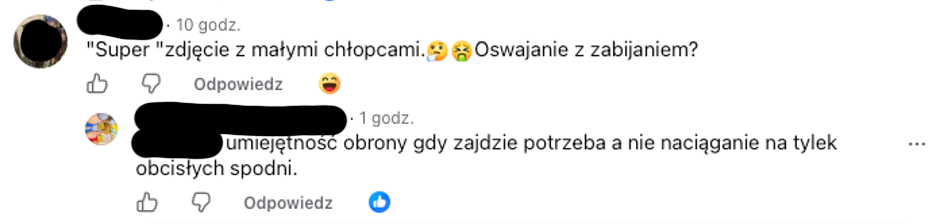
A comment like this appeared under one of the posts describing CSJ’s activities and featuring photographs of young participants attending classes at our Centre. In fact, it was this comment that prompted us to write this article.
Not because we want to argue with its author or convince anyone that they have no right to think this way. Quite the opposite. The comment illustrates a problem that goes far beyond a single online discussion.
Why does the sight of a child and a firearm so easily trigger associations with killing?
Where does the belief come from that showing a young person a firearm, explaining how it works and teaching them the rules of safety is fundamentally different from teaching them how to use a car, knife or tools safely—or how to behave during a fire?
And most importantly, where do we actually get the knowledge on which we base such judgements?
For a large part of society, exposure to firearms is limited to films, television series, video games and news reports about wars, terrorist attacks or crime. When, for years, we see firearms almost exclusively in the hands of people shooting at other people, it is very easy to build a simple equation:
firearm = killing.
But that equation says more about the way firearms are presented to us than it does about reality.
That is precisely why we created the “Demystifying Firearms” programme at the Jammas Shooting Centre.
Not to encourage children to shoot.
Not to turn them into future customers of our store.
And not to persuade everyone that they should own a firearm.
The purpose is much simpler: to replace associations with knowledge.
Training young people will not generate quick sales. A teenager attending one of our sessions will not leave the classroom and buy a pistol. From a business perspective, it would be much easier to spend that time on people who already hold firearms licences and are able to make purchases.
And yet we continue to run these sessions.
Because we believe that, as an organisation operating very actively within the industry, our role extends beyond simply selling equipment.
We want to build awareness.
That applies both to young people, who know firearms mainly from screens, and to adults who have just received their firearms licence and are preparing to make their first purchase.
A car can kill. So why do we teach young people to drive?
A car is one of the most useful tools in the modern world, yet when used improperly, it can take a life within seconds.
Despite this, we do not describe driving lessons as “desensitising people to killing”.
Parents allow young people to learn about cars, prepare them for their driving tests, teach them to anticipate situations on the road and understand the responsibility involved in controlling several tonnes of moving mass.
Why?
Because we understand the difference between a tool and the way it is used.
The same applies to boxing. A child learning how to throw a punch is not being prepared to attack people in the street. They are learning a sport, discipline, emotional control and how to operate within a defined set of rules.
We show children how to use knives safely, even though a knife can kill. We teach them how to handle fire, even though fire can burn down a house. We attend occupational health and safety and fire-safety training not because we want to encourage an interest in accidents, but because understanding a hazard reduces the risk.
So why do we so often try to apply the opposite principle to firearms?
If we do not explain firearms, Hollywood will
We can choose not to talk to young people about firearms. We can avoid showing them. We can decide that the subject should be reserved exclusively for adults.
The problem is that young people will encounter firearms anyway.
Only through a screen.
And screens portray firearms in ways that have little to do with reality. A hero hits the target while running, an opponent drops dramatically after a single shot, magazines appear to contain an endless supply of ammunition and accurate shooting requires no training whatsoever.
In video games, it is even simpler: the firearm becomes an extension of the cursor.
If this is left as a young person’s primary source of knowledge, we should not be surprised when they make the association:
a person with a firearm = someone who is about to shoot people.
The purpose of “Demystifying Firearms” is to take that image apart.
We show real firearms. We explain how they are constructed, how they work, what causes a shot to be fired, how much energy a projectile carries and why a single mistake can have irreversible consequences.
A firearm stops being a cinematic artefact that “spits fire”.
It becomes a mechanism.
But the respect for it does not disappear.
And that is exactly how it should be.
Demystifying does not mean trivialising.
Safety first, shooting later
One of the greatest misconceptions about shooting education is the belief that its primary purpose is to teach someone how to hit a target.
From our perspective, something else matters far more.
The first priority is to teach people how not to harm themselves or anyone else.
That is why we begin with safety rules, the BLOS firearm-safety principles, muzzle direction, trigger-finger discipline, checking the condition of the firearm and maintaining awareness of what is in front of and behind the target.
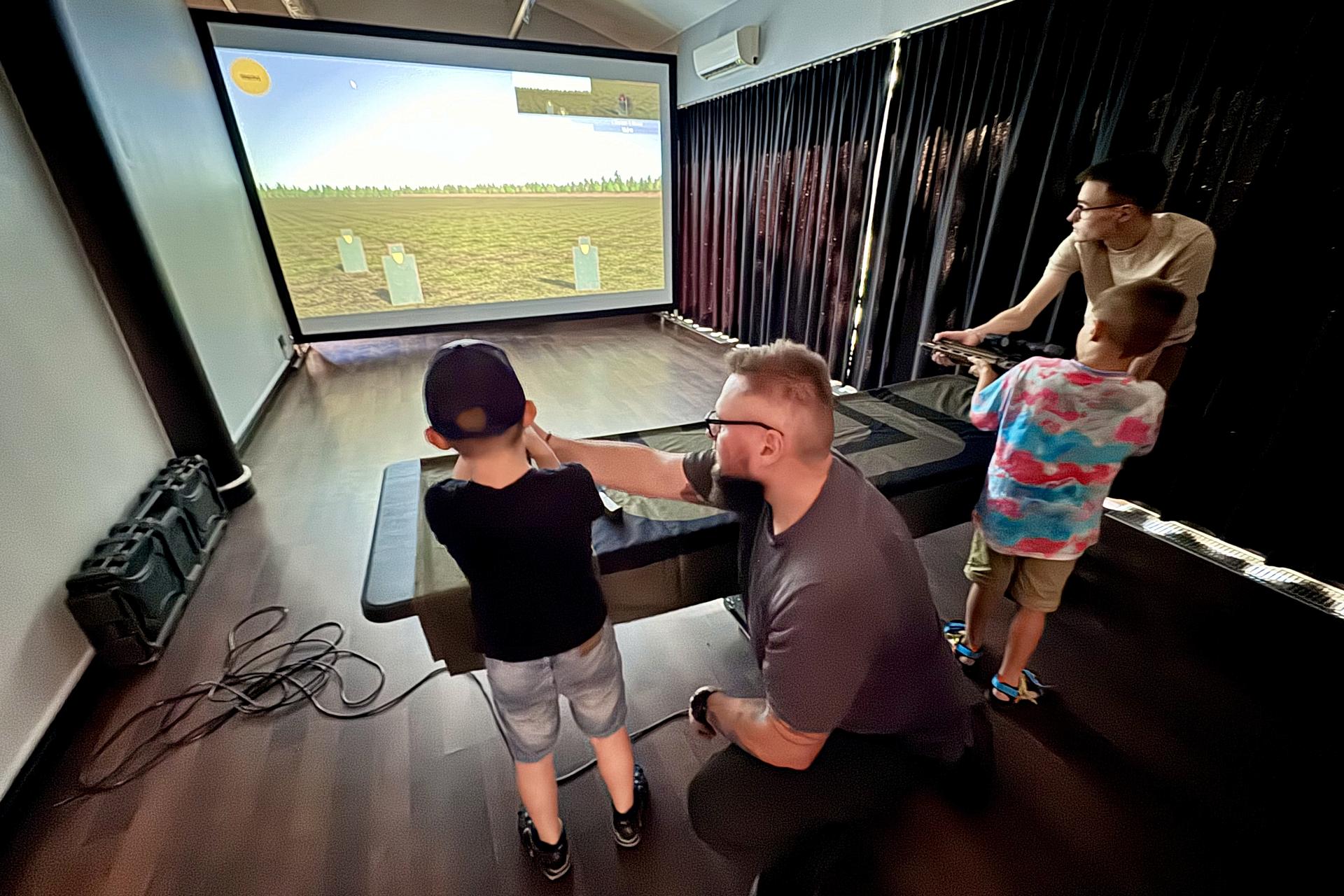
When working with young people, we use a multimedia training system and laser-based firearm replicas. Participants can learn how a pistol or carbine is handled without coming into contact with live ammunition.
This is practical safety education.
Not training in how to kill.
If a young person ever accidentally finds a firearm or sees one somewhere unexpected, we do not want their reaction to be curiosity fuelled by mystery.
We want them to know:
I do not touch it, I do not handle it, I do not point the muzzle anywhere, and I inform an adult or the relevant authorities.
A simple “you must not” offers far less protection than “I understand why I must not”.
Firearms in Poland are no longer a niche subject
Today, this issue has an entirely different dimension than it did a dozen or so years ago.
There are now more than one million legally registered firearms in Poland. The shooting community is growing rapidly, as is the number of people participating in shooting sports, collecting firearms or developing their skills in other areas connected with shooting.
For us, these are not merely statistics.
We meet these people every day.
They are doctors, business owners, teachers, mechanics, IT specialists, uniformed officers, lawyers, office workers, students and pensioners. People in their twenties and people over seventy.
We are on first-name terms with many of our customers. We meet them at competitions, trade fairs, training sessions and shooting ranges. We compete, exchange experiences and discuss equipment and technique.
From this perspective, one can see something that often remains invisible from the outside.
The Polish shooting community is extremely diverse, but it is also firmly rooted in discipline and responsibility.
We do not see a community built around macho posturing and the message:
“I have a gun, so watch out.”
What we see instead is a culture in which one irresponsible movement on the firing line is immediately noticed and safety is monitored by everyone.
That does not mean every firearm owner is perfect. No large social group can meet such a standard.
But the presence of more than one million legally registered firearms in the country also teaches us something.
Our streets have not turned into the Wild West.
And that is precisely why educating young people is becoming increasingly important
As the number of legally owned firearms in society increases, so does the likelihood that someone may encounter one outside a film or video game.
That does not mean we should make children indifferent to the sight of firearms.
We do not want firearms to become ordinary, unremarkable objects to them.
But neither do we want them to trigger automatic panic.
If a young person sees someone carrying a firearm in public, the mere presence of that firearm does not necessarily mean they are looking at a criminal preparing to attack.
They may be looking at a police officer, a security professional or a lawful firearm owner.
An informed person should neither dismiss the situation nor automatically panic.
They should assess the person’s behaviour and the surrounding context first.
Caution—yes.
Respect—always.
Panic—no.
That is situational awareness.
The knowledge gap does not disappear after obtaining a firearms licence
Interestingly, we observe a similar problem at the other end of the spectrum.
Someone comes to us after receiving their firearms licence. Legally, they are now allowed to buy their first pistol.
Suddenly, they find themselves in the middle of an enormous market.
Dozens of brands. Hundreds of models. Promotions. Rankings. Influencers. Online forums. Friends’ opinions. Manufacturers’ marketing.
Everyone insists that their solution is the best.
An experienced user can quickly filter out much of this messaging.
For someone buying their first firearm, it is far more difficult.
The best trigger.
The most reliable pistol.
A service-grade model.
The biggest discount.
“The best choice for your first firearm.”
But before answering the question of what to buy, we first need to answer a different question: what for?
- Sport?
- Recreation?
- Carrying?
- Training?
- Collecting?
How large are the user’s hands? How well do they manage a particular trigger system? Are they planning to use an optic? How important is the availability of magazines and spare parts? How often will they train?
There is no single “best pistol”.
There are only pistols that are more or less suitable for a particular person and their needs.
That is why CSJ’s training programmes are not aimed exclusively at people who have never seen a firearm before.
We also want to educate those who have already entered the shooting community.
Sometimes the best sale is no sale at all
This may sound strange in an article published by a company that, among other things, sells firearms, but sometimes we genuinely prefer a customer not to buy anything immediately.
When someone does not yet know what they need, it is far more sensible to gain knowledge first.
Test several options.
Speak to an instructor.
Understand the differences.
Only then reach for the wallet.
Someone who buys a firearm solely because it was discounted or because someone online claimed it was “currently the best model” may, by chance, make an excellent purchase.
But they may also spend years owning equipment that is completely unsuited to their needs.
We want informed users.
Because an informed customer makes better purchasing decisions—but, more importantly, also becomes a safer shooter.
We do not want CSJ to be built solely as a store
The Jammas Shooting Centre is a business, and we do not pretend otherwise.
We sell.
We train.
We operate a gunsmithing workshop.
We organise events.
But as the project develops, it is becoming increasingly important to us that CSJ should also be a place where knowledge is exchanged.
A place where someone can come in and say:
“I do not know much about this. I want to understand.”
Without embarrassment.
Without having to pretend to be an expert.
Without feeling that every question must end with a purchase.
This applies to young people learning the foundations of safety.
To parents who have never had any previous contact with firearms.
To someone visiting a shooting range for the first time.
To a new firearms licence holder.
And to an experienced shooter who wants to learn something new.
That is why we treat “Demystifying Firearms” as something broader than the name of a single training course.
It describes an important part of our philosophy.
Separating facts from myths.
Showing before judging.
Explaining instead of frightening.
Teaching responsibility instead of leaving people with an image created by films and television.
So let us return to the question from the beginning
“Desensitising people to killing?”
No.
Preparing them for reality.
If, after attending our classes, a young person understands that a firearm is not a toy, knows how to behave around one, understands the basic rules of safety and can distinguish Hollywood fiction from reality, then we have achieved our goal.
If they become a shooter one day—excellent.
If they never want anything to do with firearms again—that is also perfectly fine.
The knowledge will remain.
And safety knowledge is never something worth economising on.
Not every child who learns to use a knife safely will become a chef.
Not every child who learns the rules of the road will become a racing driver.
And not every young person who learns the rules of safe firearm handling will become a soldier or a shooter.
But any one of them may one day find themselves in a situation in which that knowledge proves necessary.
That is why, at CSJ, we do not want merely to sell firearms. We also want to teach people what they really are.
Because awareness does not increase danger.
Awareness makes it possible to recognise it.
