







Which First Pistol? The Internet Has Already Chosen. It Just Doesn’t Know Who For
You ask which pistol to buy first. A friend recommends a Glock, your instructor says CZ, and SIG has just won on YouTube. ChatGPT produces a table and confidently announces that, within your budget, yet another model is the best choice. It all looks very professional.
There is just one person missing from the conversation.
You.

Nobody has established how you want to shoot, what you have already tried, what your hands are like, or what you actually expect from your own pistol. But somehow, the model has already been chosen. Several of them, in fact, just in case the first answer did not leave you with enough doubts.
Let’s put it plainly: a forum or a chat window is not the best place to settle the question, “Which pistol should I buy?” You can find a huge amount of useful knowledge there — user experience, sensible comparisons and plenty of things worth checking for yourself later.
The problem begins when we turn that information into a ready-made decision for a specific person we actually know almost nothing about.
I am writing this from the perspective of a shop owner who has served tens of thousands of customers over the past ten years. We meet people when they buy their first pistol, see them again after more training, when they come back for another firearm, for modifications or for service work. Sometimes we also find out why the pistol that seemed perfect six months earlier no longer seems quite so perfect.
And from that perspective, choosing your first pistol looks a little different from an online ranking.
„This is the best pistol for a beginner”
What that usually means is something closer to:
“I own one, and I’m happy with it.”
That is a perfectly fair recommendation — right up until someone’s own “I am” quietly turns into somebody else’s “you will be”.
Tomek and Zbyszek may have exactly the same budget and still need two completely different pistols. One wants to shoot dynamically, the other prefers slow, deliberate target shooting. One will go to the range several times a month, the other a few times a year. They have different hands, different experience, different expectations — and they may simply like different things.
A box labelled “best pistol under PLN 5,000” does not solve any of that.
That is why several people can confidently recommend contradictory options and each of them may still be right. The problem is that they are usually answering the question:
“What worked for me?”
rather than:
“What will work for you?”
With a first purchase, that distinction is easy to miss. Especially when the road to obtaining a firearms licence has mostly meant paperwork, an exam and a handful of range visits. The document is already in your hand, but your own preferences may barely exist yet.
Someone else’s certainty can sound very tempting at that point.
In the shop, we actually much prefer hearing:
“I’m not really sure yet.”
Because that is something you can build a useful conversation around.
„So maybe something universal, since I don’t know yet?”
This is probably the most common way people try to solve the problem.
If I do not yet know what kind of shooting will really draw me in, I will buy something as universal as possible. Something that can do everything, will not hold me back six months from now and, ideally, will require no compromises whatsoever.
The problem is that such a pistol does not exist.
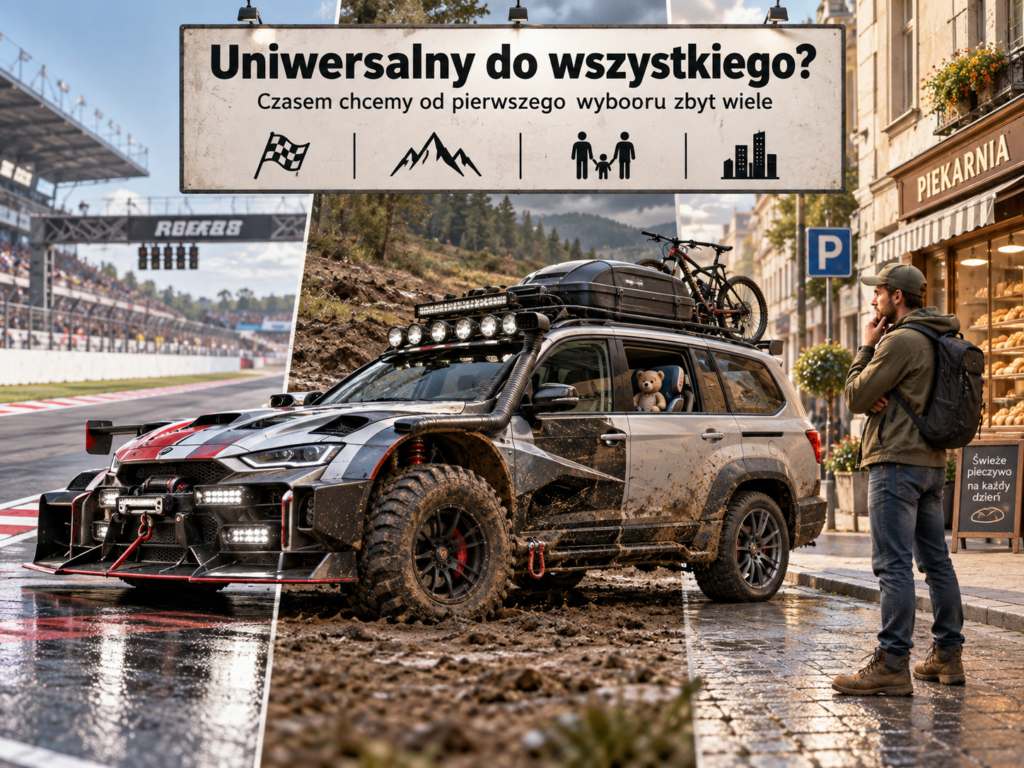
There are designs that let you try many different types of shooting. Some will be more comfortable than others in particular applications. But “I can try lots of things with it” and “it is equally good at everything” are two very different promises.
The second is a little like looking for a car that can win a Formula 1 race, cope with serious off-road terrain, carry the family comfortably on holiday and still slip effortlessly into a parking space outside a bakery in a crowded city centre.
There is a paradox here, though.
For its owner, the first pistol will usually become universal anyway.
It is the pistol with which you start trying different things. You take it to a dynamic shooting course, shoot paper targets, fit a red dot — or discover that you do not actually want one. You begin noticing things you had no idea mattered when you bought it.
What becomes universal, then, is the way you use that first pistol.
Not some magical combination of features built into it.
Of course, that does not mean every model is an equally good starting point. It simply means there is little sense in expecting your first purchase to solve every future need you may ever have.
If shooting stays with you for longer, there is a good chance one pistol will not be the end of the story anyway.
You can start with a design that suits whatever seems most interesting to you today. After a few months — or a few thousand rounds — the next choice will be made by a very different person: someone with their own experience, rather than just other people’s opinions.
And if the second pistol turns out to be completely different from the first, that does not automatically mean the first purchase was a mistake.
Perhaps the first one was exactly what helped you discover what you actually wanted from the next.
The instructor said so. The operator uses it. The competitor recommends it.
There is nothing wrong with listening to people who have experience.
Quite the opposite.
The problem starts when we forget to ask where that experience comes from.
A top competitor understands the requirements of their discipline. An instructor sees technique, recognises shooter errors and knows which equipment is easier to work with during training. A soldier or law-enforcement officer knows equipment used for specific tasks and procedures.
Each of them may know an enormous amount about firearms.
But their perspective does not necessarily match the perspective of someone buying their first pistol for themselves.
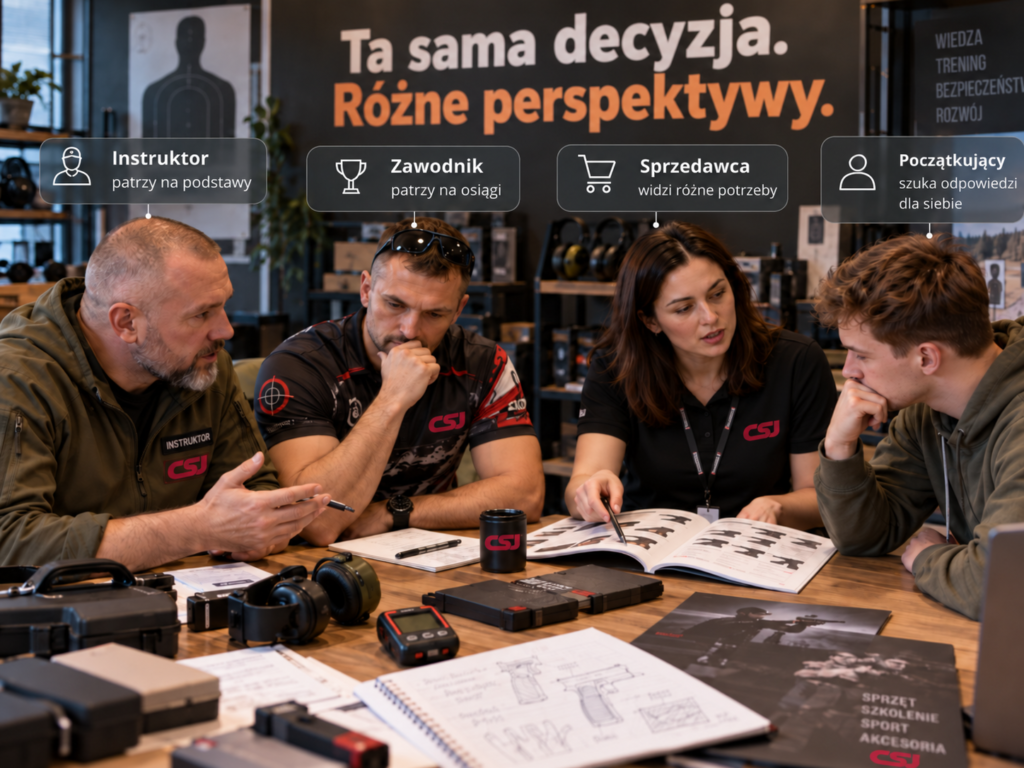
A shop sees something different again.
Through the door come all of the people mentioned above, along with beginners, collectors, recreational shooters, competitors and the person who has wanted one particular model for fifteen years because they once saw it in a film and it became a dream gun.
We also see what happens afterwards.
Customers return for another firearm, parts, modifications or service work. They tell us what worked, what irritated them and what they would not choose again next time.
That does not mean the shop “knows better” than an instructor or a competitor. It simply has a different cross-section of experience — one that can be extremely useful when helping very different people find equipment that suits them.
Of course, simply having “gun shop” above the door does not automatically create that expertise.
If a salesperson recommends, after thirty seconds of conversation, the exact pistol they happen to have the most of in stock, it is worth asking where that recommendation actually came from.
A good salesperson should be able to explain the reasoning.
And sometimes say:
“I don’t know enough about you yet to recommend anything.”
„Metal is better.” “Why would you want all that extra weight?”
This is one of those arguments where two people can disagree for hours while, in reality, talking about two completely different things.
One user carries a firearm for many hours and eventually notices every additional gram. Another uses it almost exclusively at the range and does not mind the extra weight at all — in fact, they may actively prefer it.
The same applies to hammer-fired and striker-fired pistols.
The popularity of one design does not automatically mean the other belongs in a museum.
They differ in mechanism, operating characteristics, handling and the way they feel when shooting. Depending on the intended use, exactly the same feature may be an advantage for one person and a disadvantage for another.
It is also worth separating the firing mechanism from the frame material, because the internet loves quickly dividing everything into two camps:
metal and hammer versus polymer and striker.
That makes it easy to pick a team.
It makes it slightly harder to learn anything useful.
The differences are real and they do matter.
But instead of declaring a winner, it makes more sense to establish which of those differences actually matters to us.
„Buy the one that feels good in your hand”
Now that sounds much more sensible.
Except that a beginner has a problem here too.
After a few minutes at the counter, it is fairly easy to notice something that clearly does not fit.
The grip is too large. You have to reach unnaturally for the controls. The geometry simply does not work for you.
Those are meaningful signals.
What is much harder is deciding, after a brief handling session, that you have discovered ergonomic perfection.
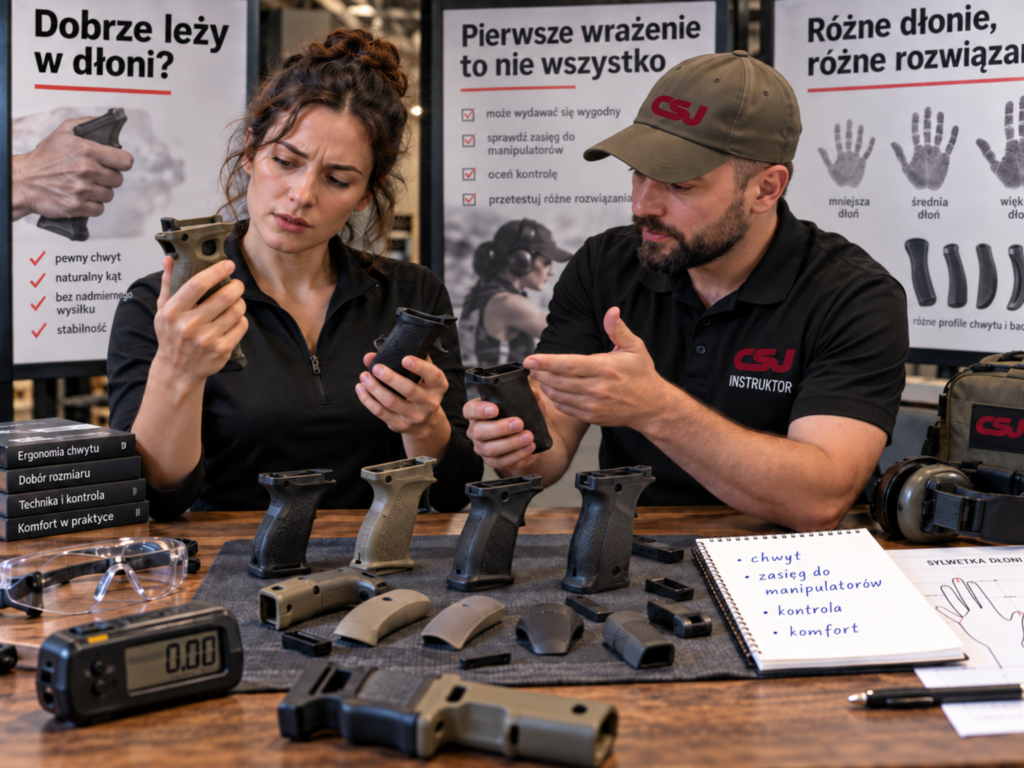
A beginner is still learning how to build a consistent grip. With training, technique changes. Strength changes. Trigger control changes. Even the things you notice in the first place begin to change.
Something that feels extremely comfortable for five minutes may feel very different after a longer shooting session.
That is why “it fits my hand well” can mean something very different when said by an experienced shooter who has reached that conclusion after many hours of training.
For a beginner, it is more often a first impression.
And there is nothing wrong with that.
You just need to understand how much weight to give that first impression.
„I shot one. Never again.”
If possible, it is worth shooting a pistol before making a decision.
We use demonstration firearms ourselves, and we know how much even a dozen or a few dozen rounds can change someone’s impression.
But once again, context matters.
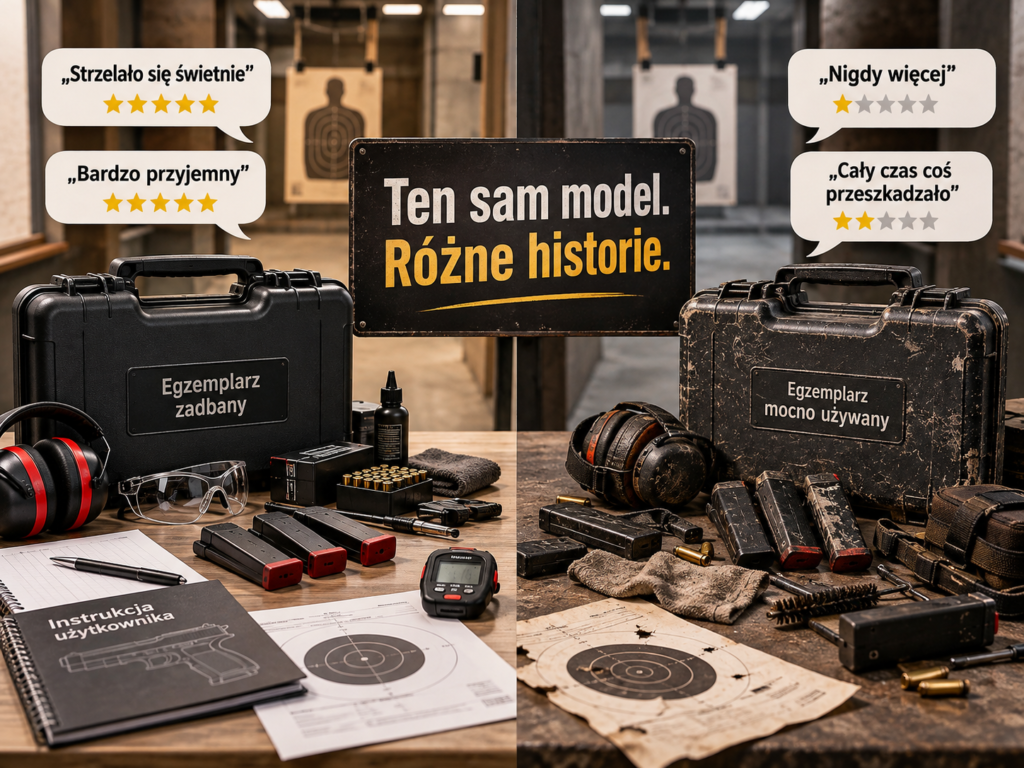
A pistol from a commercial shooting range may already have fired tens of thousands of rounds and passed through the hands of hundreds of users.
One example may be almost new. Another may have been worked very hard.
Then there is the ammunition, magazine condition, maintenance and any modifications that may have been made.
Later, two people describe the same model online even though, in practical terms, they handled firearms in completely different condition.
The same applies to reliability stories.
“Mine fired 20,000 rounds without a malfunction” is useful information.
“Mine kept jamming” is useful information too.
But before drawing conclusions about the entire design, it would be useful to know what exactly was happening with that particular example.
Working in service teaches you humility toward internet legends very quickly.
Pistols that are supposedly indestructible arrive on the bench. So do models that half the internet insists are unreliable.
Sometimes the problem really is the firearm.
Sometimes it is a worn part, the ammunition or the magazine.
Sometimes the owner changed something themselves and later seems to forget why the manufacturer never offered that configuration in the first place.
And every now and then, someone buys a hand-fitted pistol and appears to assume that, at that price, cleaning should probably happen automatically.
As though discreet housekeeping were included in the package.
The point is not to blame the user by default.
The point is to understand what actually happened before passing judgement on an entire model.
„For that money, you could buy something more sensible”
Perhaps.
But the owner likes this one.
That is something we occasionally forget when we try to reduce firearm choice to a spreadsheet of specifications.
Shooting is also — and perhaps above all — a hobby.
Someone wants a classic design. Someone wants a particular finish. Someone has dreamed of one specific model for years and simply wants to own it.
If they understand its limitations and consciously accept them, appearance or simple affection for a particular design can be perfectly valid reasons for choosing it.
Not every personal preference needs a technical justification attached to it.
That, incidentally, is also where the interest in coatings, engraving and customisation comes from — services we provide at CSJ.
For one person, it is an unnecessary expense.
For another, it is part of the enjoyment of owning something that is truly theirs.
Price does not put every customer into the same category either.
You can pay more for a feature you genuinely need. You can pay more for the way something looks. Or you may decide that neither matters to you in the slightest.
But it is always worth knowing what you are actually paying for.
Instead of asking “What should I buy?”, start with a few simpler questions
You do not need to know immediately what kind of shooting will interest you three years from now.
By definition, we make our first choice with less experience than our second or third.
But we can usually establish a little more than just the budget.
What have we already shot?
What did we like about it, and what bothered us?
Is there a type of shooting that interests us more than others right now?
How often do we realistically intend to train?
Are we planning to use an optic?
Does weight matter to us?
Do we already have clear preferences regarding the mechanism, controls or overall size?
And sometimes just as importantly:
is there a pistol we simply like?
This is not about completing a questionnaire after which a computer displays the one correct model.
It is about having something meaningful to discuss.
If someone walks in and says:
“I have three pistols on my shortlist,”
we are interested not only in which three models they are.
The much more interesting question is:
Why those three?
Very often, the answer tells us more about that person’s actual needs than the model names themselves.
Sometimes, after that conversation, the shortlist drops to two.
Sometimes a fourth option appears.
And sometimes we conclude that the best thing to do is shoot a little more and come back to the subject in a month.
That is a perfectly good answer too.
That is why we prefer explaining things to handing out rankings

During our pistol-selection workshops, we talk about what different designs were created to do, and how they differ in ergonomics, weight, materials, mechanisms and future configuration options.
We show different approaches and answer the questions people actually bring with them.
Not so that everyone leaves the session with the name of exactly the same model.
If, after the conversation, someone still wants the pistol they liked from the beginning — but can now explain why — that is completely fine.
If they change their mind, that is fine too.
We do not have one universal pistol for every beginner.
And, realistically, neither does anyone else.
What we do have is years of conversations with very different people and the opportunity to see what happens long after that first:
“I’ll take this one.”
So instead of asking only:
“Which first pistol should I buy?”
it makes more sense to begin by establishing what that first pistol is actually supposed to be for.
The model name can come later.
(Images featured in this article were generated using AI.)
